(セミナー)日本におけるSEPの最新裁判例 Seminar on Japanese SEP Cases in Keio University
- Toshi Futamata
- 1月24日
- 読了時間: 2分
(English Executive Summary follows)
January 24, 2026 by Toshi Futamata
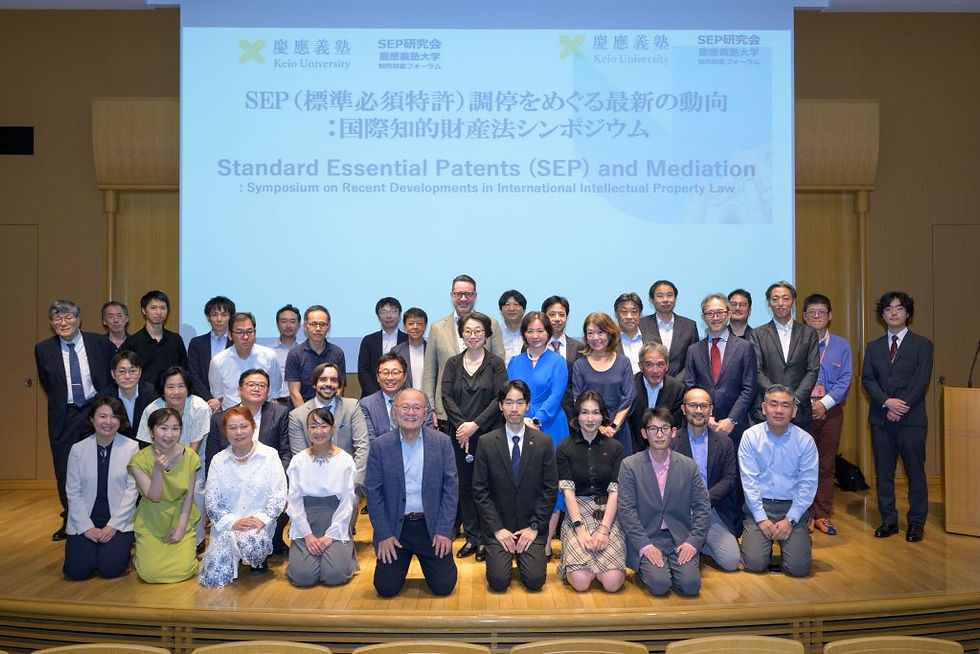
1月21日先日の東京地裁の判決を中心に検討するセミナー「日本における標準必須特許(SEP)の最新裁判例と課題」がSEP研究会と慶應大学KGRIとの共催で行われた。産官学法曹の関係者140名超が参加され、様々な視点から最新のPantech v Google東京地裁判決など最新のSEP判決が検討された。当日登壇された紋谷崇俊弁護士の「日本におけるSEP裁判例」のスライドを公開させていただく。

Attorney Monya

(From left) Attorney Monya, Attorney Matsunaga, Chairman Futamata and Prof. Kimishima
セミナーのあとには懇親会が開かれ、大勢の業界関係者、法曹関係者が参加し、SEPを巡るフランクな議論の場となった。今回のイベントはSEP研究会の臨時公開イベントとして開催された。
Here is a concise English summary of the presentation of Mr. Monya :
This presentation, dated January 21, 2026, analyzes recent Japanese court rulings on SEPs, focusing on the criteria for granting injunctions based on FRAND declarations.
1. Key Leading Case: Apple v. Samsung (2014)
• The Framework: Established that seeking an injunction on an SEP after a FRAND declaration can be considered an abuse of rights.
• The Criteria: An injunction is generally denied unless the patent holder proves that the implementer is an unwilling licensee.
• Damages: Damages are typically limited to an amount equivalent to a FRAND royalty.
2. Landmark Ruling: Pantech v. Google (June 2025)
• Case Overview: Pantech (X) sought an injunction against Google’s Japanese subsidiary (Y) regarding LTE standards used in the Pixel 7.
• First Injunction Granted: This marked Japan’s first case where an injunction was granted for an SEP.
• The Reason for the Decision:
• The court recommended a settlement based on a Global SEP Portfolio.
• While the patent holder (Pantech) cooperated, Google refused to disclose sales data and rejected the court-suggested calculation method (the "Grand Panel" method).
• The court ruled Google was an unwilling licensee because it effectively closed the door on negotiations.
3. Comparison of Recent Outcomes
Pantech v Google (Tokyo) Injunction Granted.
Pantech v Asus(Tokyo) Injunction Denied
Pantech v Google(Osaka) Injunction Denied
4. Significance and Trends
• Shift to Substance: Courts are moving from formalistic "Grand Panel" rules to a substantive assessment of "good faith" in negotiations.
• Global Alignment: Japanese courts are increasingly seeking global dispute resolutions, often utilizing court-mediated settlements for entire global portfolios.
•The "Unwilling" Threshold: Refusing to provide basic financial data (sales/volume) during court-mediated negotiations was considered as a critical factor in being labeled an "unwilling licensee" in this case.
5. Guideline on SEP litigations by District Court of Tokyo


コメント